Uniform logarithmic Sobolev inequalities for the 2D Coulomb gas at the diffusive temperature scale, Part II
A full labeled, particle-number-uniform logarithmic Sobolev inequality for every fixed inverse temperature
I have posted my paper Uniform logarithmic Sobolev inequalities for the 2D Coulomb gas at the diffusive temperature scale on arXiv. It proves that, for every fixed inverse temperature \(\beta>0\), the canonical planar Coulomb gas at the diffusive temperature scale satisfies a logarithmic Sobolev inequality on the full labeled configuration space, with a positive constant independent of the particle number. The lower bound can be chosen uniformly when \(\beta\) ranges over a compact subset of \((0,\infty)\).
This is the second part of a two-part exposition. Part I gave a perturbative proof, ultimately reaching \(0<\beta<1\), and isolated the two conditional estimates that prevented that argument from continuing to arbitrary inverse temperature. The new paper solves precisely that weighted one-particle problem for every finite total exponent. Once this nonperturbative input is inserted into the many-particle architecture from Part I, the restriction on \(\beta\) disappears.
The new input is strongly harmonic-analytic. Its proof combines planar quasiconformal geometry, strong-\(A_\infty\) weights, a critical weak-\(L^2\) estimate for logarithmic force fields, and the two-dimensional Ladyzhenskaya inequality. The full many-particle argument is broader: it synthesizes those ingredients with complex analysis, conditional entropy, random transpositions, a repulsive partition estimate, and the defective-LSI-plus-Poincaré tightening argument.
1 What Part I left open
Identify \(\R^2\) with \(\C\), set \(\mathsf g(z)=-\log|z|\), and consider the Hamiltonian
\[ \cH_N(Z) :=\frac12\sum_{i=1}^N |z_i|^2 +\frac1N\sum_{1\le i<j\le N}\mathsf g(z_i-z_j), \qquad Z=(z_1,\ldots,z_N)\in\C^N. \]
The associated canonical Gibbs measure is
\[ \dd\Pbb_{N,\beta}(Z) =\mathsf Z_{N,\beta}^{-1} e^{-\beta|Z|^2/2} \prod_{i<j}|z_i-z_j|^{\beta/N}\,\dd Z. \tag{1} \]
The factor \(N^{-1}\) in the pair exponent is the diffusive-temperature normalization: the noise amplitude in the reversible overdamped dynamics does not vanish as \(N\to\infty\). The question is whether there exists, for each fixed \(\beta>0\), a constant \(\rho_*(\beta)>0\), independent of \(N\), such that
\[ \Ent_{\Pbb_{N,\beta}}(f^2) \le \frac{2}{\rho_*(\beta)} \int_{\C^N}|\grad f|^2\,\dd\Pbb_{N,\beta} \tag{2} \]
for arbitrary real observables on the full labeled space.
Part I showed how the many-particle problem reduces to weighted planar conditional measures. A one-site conditional has the form
\[ \dd\Pbb_i(z\mid Z_{-i}) \propto e^{-\beta|z|^2/2} \prod_{j\ne i}|z-z_j|^{\beta/N}\,\dd z, \tag{3} \]
whose total exponent is \(\beta(N-1)/N<\beta\). The label-dependent part of the Poincaré problem is controlled by freezing a pair center and all other particles. In the orthonormal relative coordinate \(u=(z_i-z_j)/\sqrt2\), the conditional density is proportional to
\[ e^{-\beta|u|^2/2} \left|u\prod_{k\ne i,j} \left(A_k^2-\frac{u^2}{2}\right)\right|^{\beta/N}\,\dd u, \tag{4} \]
where the points \(A_k\) depend on the frozen environment. The polynomial in (4) has degree \(2N-3\), so the total exponent is
\[ \frac{\beta(2N-3)}{N}<2\beta. \tag{5} \]
The perturbative argument in Part I controlled these measures through reciprocal-weight estimates. Those estimates impose a smallness condition on the total exponent, which is why the proof stopped at \(\beta<1\). This was a limitation of the weighted criterion, not evidence for a phase transition in the logarithmic Sobolev inequality. The exact problem left at the end of Part I was therefore:
Prove Poincaré and logarithmic Sobolev inequalities for Gaussian measures multiplied by arbitrary finite products of positive powers of planar distances, with constants controlled only by the Gaussian variance and the sum of the exponents—not by the number, positions, multiplicities, or clustering of the points.
The new weighted theorem answers this question at every finite total exponent.
2 What the paper proves
Let
\[ \mathcal C_N:=\{Z\in\C^N:z_i=z_j\text{ for some }i\ne j\}, \qquad \Omega_N:=\C^N\setminus\mathcal C_N, \]
and let \(\Dform_{N,\beta}\) be the closed Dirichlet-form domain generated by \(C_c^\infty(\Omega_N)\) under the norm
\[ \|f\|_{L^2(\Pbb_{N,\beta})}^2 +\int_{\C^N}|\grad f|^2\,\dd\Pbb_{N,\beta}. \]
The first theorem is the main result of the paper.
For every compact interval \(I\Subset(0,\infty)\), there exists \(\rho_I>0\) such that, for every \(\beta\in I\), every \(N\ge2\), and every real-valued \(f\in\Dform_{N,\beta}\),
\[ \Ent_{\Pbb_{N,\beta}}(f^2) \le \frac{2}{\rho_I} \int_{\C^N}|\grad f|^2\,\dd\Pbb_{N,\beta}. \tag{6} \]
In particular, for every fixed \(\beta>0\), the logarithmic Sobolev constants are bounded below uniformly in \(N\).
The theorem is proved directly for the singular, unregularized law. Every collision stratum has zero weighted capacity, so the collision-free core closes to the natural weighted Sobolev form; there is no ultraviolet cutoff and no cutoff-removal step hidden in the argument. The observable class is the full labeled Dirichlet-form domain, not merely the permutation-invariant sector or the class of functions of the empirical measure.
The analytic core is the following one-particle result.
Fix \(\gamma>0\) and \(Q<\infty\). Let \(y_1,\ldots,y_m\in\C\) and \(a_1,\ldots,a_m\ge0\) satisfy \(\sum_j a_j\le Q\), with coincident points combined. Define
\[ \dd\nu(z) :=Z^{-1}e^{-\gamma|z|^2/2} \prod_{j=1}^m |z-y_j|^{a_j}\,\dd z. \tag{7} \]
There are constants \(C_{\wt}(\gamma,Q)<\infty\) and \(\rho_{\wt}(\gamma,Q)>0\), depending only on \((\gamma,Q)\), such that
\[ \Var_\nu(f) \le C_{\wt}(\gamma,Q)\int_{\C}|\grad f|^2\,\dd\nu, \tag{8} \]
and
\[ \Ent_\nu(f^2) \le \frac{2}{\rho_{\wt}(\gamma,Q)} \int_{\C}|\grad f|^2\,\dd\nu. \tag{9} \]
The constants are independent of \(m\), of the point configuration, of all multiplicities and collisions among the \(y_j\), and of the individual exponents, subject only to \(\sum_j a_j\le Q\).
Dilation fixes the \(\gamma\)-dependence:
\[ C_{\wt}(\gamma,Q)=\gamma^{-1}C_{\wt}(1,Q), \qquad \rho_{\wt}(\gamma,Q)=\gamma\rho_{\wt}(1,Q). \tag{10} \]
This theorem is the precise nonperturbative replacement for the two conditional estimates that failed beyond \(\beta<1\) in Part I.
3 The harmonic-analytic core: weighted Gaussians with point zeros
Write
\[ w(z):=\prod_{j=1}^m|z-y_j|^{a_j}, \qquad q:=\sum_{j=1}^m a_j\le Q. \tag{11} \]
Evidently, the weight vanishes at the points \(y_j\), and therefore is not singular. What is singular is \(\log w\) and its gradient. The proof separates the local geometry near these zeros from the global behavior at infinity.
3.1 Strong-\(A_\infty\) geometry near the zeros
For a locally integrable weight \(w>0\) almost everywhere on \(\R^2\), let \(B_{xy}\) be the Euclidean ball having the segment from \(x\) to \(y\) as a diameter, and define
\[ \delta_w(x,y) :=\left(\int_{B_{xy}}w\right)^{1/2}. \tag{12} \]
Define also the path metric
\[ d_w(x,y) :=\inf_\Gamma\int_\Gamma w^{1/2}\,\dd s, \tag{13} \]
where the infimum runs over rectifiable curves joining \(x\) to \(y\). Following David–Semmes and Semmes, a doubling weight is called strong \(A_\infty\) when the two quantities are quantitatively comparable:
\[ C^{-1}\delta_w(x,y) \le d_w(x,y) \le C\delta_w(x,y) \qquad\text{for all }x,y\in\R^2. \tag{14} \]
The distinction from ordinary Muckenhoupt theory is important; see, for example, Grafakos [Gra14] for the standard theory of Muckenhoupt weights and \(A_p\) classes. Membership in \(A_\infty\) is a measure-theoretic condition. Strong \(A_\infty\) is a metric-geometric condition: \(d_w\) is the path distance associated with the conformal metric \(w^{1/2}|\dd z|\), while \(\delta_w\) measures distance through the weighted area of the ball spanning the two points. Quantitative comparability says that these two geometries agree at every scale. The class was introduced by David and Semmes in connection with quasiconformal mappings and Sobolev inequalities, and developed further by Semmes [DS90, Sem93].
For the point-power weight (11), set \(\rho=w^{1/2}\). Distributionally,
\[ -\Delta\log\rho =-\pi\sum_{j=1}^m a_j\delta_{y_j}. \tag{15} \]
Thus the associated conformal metric has no positive curvature mass and total negative curvature mass \(\pi q\). Bonk and Lang’s parametrization theorem [BL03] gives a quasiconformal homeomorphism \(F:\C\to\C\) whose Jacobian satisfies
\[ C_Q^{-1}J_F\le w\le C_QJ_F. \tag{16} \]
Semmes’s quantitative framework then implies that \(w\) is strong \(A_\infty\), with constants controlled only by \(Q\). Björn’s self-improvement results [Bj01] yield a local weighted Sobolev inequality: there exist \(\kappa_Q>1\), \(\Lambda_Q\ge1\), and \(C_Q<\infty\) such that, for every Euclidean ball \(B=B(x,r)\),
\[ \left( \frac1{w(B)}\int_B |f-f_{B,w}|^{2\kappa_Q}w \right)^{1/(2\kappa_Q)} \le C_Qr \left( \frac1{w(\Lambda_QB)}\int_{\Lambda_QB}|\grad f|^2w \right)^{1/2}. \tag{17} \]
The geometric content is that clustering does not create a new local obstruction. Ten points with total exponent \(q\), a hundred coincident points whose exponents add to \(q\), and a diffuse collection of points with the same total exponent all generate conformal metrics whose relevant quantitative geometry is controlled by \(q\). This is the mechanism behind the configuration-uniform local estimates.
The Gaussian factor in (7) is smooth and bounded above and below on a fixed ball. Consequently, (17) transfers to the weighted Gaussian measure on bounded disks, with constants depending only on the disk radius, \(\gamma\), and \(Q\). Local control is therefore complete. What remains is to prevent the measure, or a low-energy test function, from escaping to infinity.
3.2 Weak-\(L^2\) logarithmic fields and Gaussian confinement
The first global step is normalization. If
\[ \mathsf A:=\prod_j(1+|y_j|)^{a_j}, \]
then
\[ c_{\gamma,Q}\mathsf A\le Z\le C_{\gamma,Q}\mathsf A. \tag{18} \]
After division by this common factor, the probability measure has a Gaussian tail with only a fixed polynomial loss. In particular, a disk of radius depending only on \((\gamma,Q)\) contains at least half of the mass, uniformly over all point configurations.
The more delicate issue is the score. Define the logarithmic force field
\[ H(x):=\grad\log w(x) =\sum_j a_j\frac{x-y_j}{|x-y_j|^2}, \tag{19} \]
and the negative score
\[ F(x):=\gamma x-H(x). \tag{20} \]
The kernel \(|x|^{-1}\) is at the critical weak-\(L^2\) scale in two dimensions. A maximal-function argument gives the configuration-uniform estimate
\[ \bigl|\{x\in\R^2:|H(x)|>t\}\bigr| \le Cq^2t^{-2}, \qquad t>0. \tag{21} \]
Now consider an annulus \(|x|\simeq R\). The Gaussian part of the score has size \(\gamma R\). It can be substantially canceled only on the exceptional set
\[ E_R:=\{x:|x|\simeq R,\ |F(x)|<\gamma R/2\}. \]
On \(E_R\), one has \(|H(x)|>\gamma R/2\), so (21) gives
\[ |E_R|\lesssim_{\gamma,Q}R^{-2}. \tag{22} \]
Outside \(E_R\), the score directly controls \(R^2|\psi|^2\). The exceptional set is small, but small area alone is not enough: a Sobolev function could, in principle, concentrate there. This is exactly where the planar Ladyzhenskaya inequality enters [FMRT01]:
\[ \|v\|_{L^4(\R^2)}^2 \le C\|v\|_{L^2(\R^2)}\|\grad v\|_{L^2(\R^2)}. \tag{23} \]
Combining Hölder with (22) and (23), after inserting an annular cutoff, gives schematically
\[ R^2\int_{E_R}|\psi|^2 \lesssim_{\gamma,Q} R\|\psi\|_{L^2(A_R^*)} \|\grad\psi\|_{L^2(A_R^*)}. \tag{24} \]
Young’s inequality turns the right-hand side into a small multiple of the quadratic moment plus a controlled gradient term. Summing over dyadic annuli and absorbing the small multiple yields the global quadratic-moment estimate. A ground-state substitution then converts this unweighted estimate into the weighted coercivity needed for the measure (7).
This weak-\(L^2\)/Ladyzhenskaya pairing is the critical global mechanism. It replaces a pointwise control of the singular field by a distributional statement: the field may be arbitrarily large, but the region on which it can compete with Gaussian confinement is too small for an \(H^1\) function to exploit without paying Dirichlet energy.
Local quasiconformal geometry controls the zeros of the weight, while critical planar harmonic analysis prevents the logarithmic field from defeating Gaussian confinement at infinity.
3.3 From local and global control to Poincaré and LSI
The local Sobolev inequality and the global quadratic-moment estimate first give a global Poincaré inequality. The same inputs, kept at a scale-dependent level, give a super-Poincaré inequality with Gaussian rate. By the standard equivalence machinery, this implies a defective logarithmic Sobolev inequality. Finally, the Poincaré inequality and Rothaus’s centering inequality [Rot85] remove the additive defect and yield the genuine logarithmic Sobolev inequality (9).
The argument is nonperturbative in \(q\): no step requires the total exponent to be small. The constants deteriorate with \(Q\), and the quasiconformal and weighted-Sobolev constants are not presently effective enough to yield sharp asymptotics as \(Q\to\infty\), but they remain finite for every fixed \(Q<\infty\). That is exactly the qualitative strength needed for every fixed \(\beta>0\).
4 Returning to the many-particle gas
The rest of the proof inserts the weighted theorem into the architecture already developed in Part I. The key distinction is between permutation-invariant fluctuations, label-dependent fluctuations, and entropy.
For \(f\in L^2(\Pbb_{N,\beta})\), let
\[ \cS f(Z):=\frac1{N!}\sum_{\sigma\in S_N} f(z_{\sigma(1)},\ldots,z_{\sigma(N)}). \]
Since \(\Pbb_{N,\beta}\) is exchangeable, \(\cS\) is conditional expectation given the unordered configuration. Hence
\[ \Var_{\Pbb_{N,\beta}}(f) =\Var_{\Pbb_{N,\beta}}(\cS f) +\|f-\cS f\|_{L^2(\Pbb_{N,\beta})}^2. \tag{25} \]
The first term is controlled by the weighted \(\bar\partial\) argument from Part I. Away from collisions, \(\log|\Delta_N|\) is pluriharmonic, so the interaction contributes no Levi curvature: the positive complex curvature comes entirely from the quadratic confinement. A weighted Hörmander–Demailly estimate [Hör65, Dem12] controls the component orthogonal to the weighted holomorphic subspace; permutation and common-phase symmetries control the holomorphic projection. This gives
\[ \Var_{\Pbb_{N,\beta}}(f) \le \frac1\beta \int_{\C^N}|\grad f|^2\,\dd\Pbb_{N,\beta} \tag{26} \]
for real permutation-invariant observables whenever \(\beta/N\le2\). The finitely many remaining values of \(N\) at fixed \(\beta\) are handled by a fixed-particle compactness argument.
The endpoint \(\beta/N=2\), equivalently \(\beta=2N\), is the unit-droplet complex Ginibre ensemble:
\[ \dd\Pbb_{N,2N}(Z) \propto e^{-N\sum_i|z_i|^2}|\Delta_N(Z)|^2\,\dd Z. \tag{27} \]
At this endpoint, (26) becomes
\[ \Var_{\Pbb_{N,2N}}(f) \le \frac1{2N} \int_{\C^N}|\grad f|^2\,\dd\Pbb_{N,2N} \tag{28} \]
for every real permutation-invariant observable. The constant is sharp, with equality in the real and imaginary center-of-mass directions. This is the optimal finite-particle symmetric, equivalently unlabelled, Ginibre Poincaré inequality obtained independently by Suzuki and Chafaï. Suzuki also determines the exact infinite-particle unlabelled spectral gap; Chafaï’s finite-particle proof uses a Vandermonde transform, holomorphic projection, and a sharp Gaussian \(\bar\partial\) estimate closely related to the complex-analytic mechanism above.
We emphasize that this is not a full labeled inequality. It turns out that the raw full labeled Poincaré rate tends to zero as \(N\to\infty\), and hence—by linearizing the logarithmic Sobolev inequality—the raw full labeled logarithmic Sobolev rate tends to zero as well. The argument is qualitative and gives no decay rate. The asymptotic behavior of the logarithmic Sobolev constant restricted to permutation-invariant observables remains open.
There is no conflict with the theorem announced here. The present theorem keeps \(\beta\) fixed, or in a fixed compact subset of \((0,\infty)\), while Ginibre scaling takes \(\beta=2N\to\infty\). The relevant observable classes are also different.
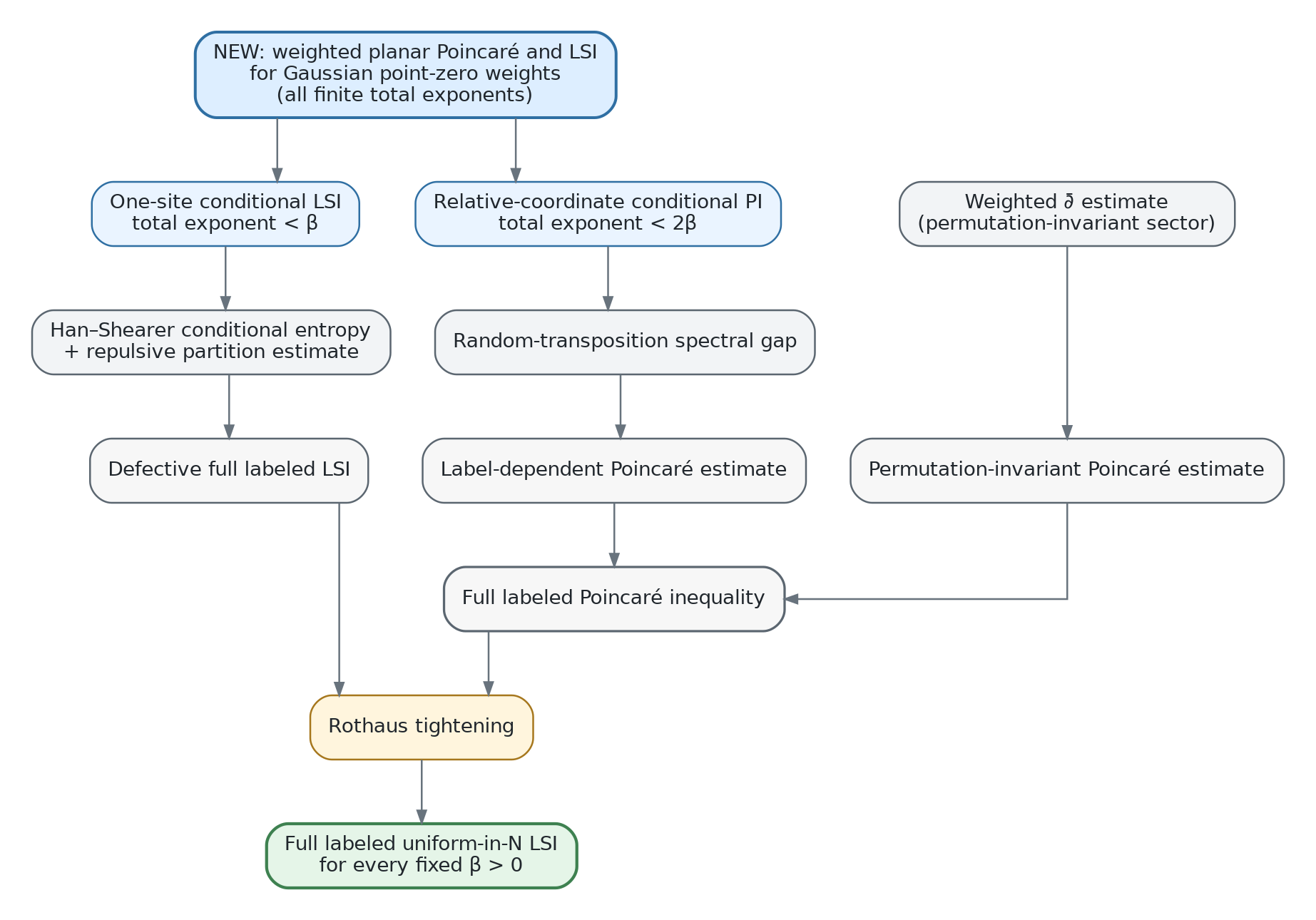
For the label-dependent term in (25), the relative-coordinate conditional (4) has total exponent below \(2\beta\). The weighted Poincaré theorem therefore applies uniformly in the frozen environment. The spectral gap of the random-transposition chain [DS81] converts these pairwise estimates into a bound on \(\|f-\cS f\|_2^2\). The factor \(N^{-1}\) from the random-transposition inequality cancels the factor \(N\) in the complete-graph gradient identity, leaving a constant independent of the number of particles. Combining this with the permutation-invariant estimate yields the full labeled Poincaré inequality.
The entropy branch is separate because (25) has no direct entropy analogue. The one-site conditional (3) has total exponent below \(\beta\), so the weighted logarithmic Sobolev theorem gives a uniform conditional LSI. A Han–Shearer conditional-entropy inequality [Han78, MT10] and the repulsive partition estimate [DG25] then yield a defective full labeled LSI. Rothaus tightening [Rot85] combines this defective inequality with the independently proved full labeled Poincaré inequality.
The full proof architecture is summarized below. Blue denotes the new input from Part II; gray denotes machinery already present in Part I.
5 What the theorem does—and does not—say
The entropy-relaxation and concentration consequences discussed in Part I therefore hold at every fixed inverse temperature; I will not repeat them here.
The theorem is specific to isotropic quadratic confinement. That confinement supplies three inputs at once: exact Gaussian separation of the center of mass, Gaussian tails for the weighted one-particle theorem, and common-phase symmetry in the permutation-invariant complex-analytic argument. For a general uniformly convex potential, the center and relative coordinates need not decouple, the conditionals are no longer Gaussian point weights, and the symmetry used in the holomorphic argument may disappear. Extending the theorem to a stable class of general confinements therefore requires quantitative replacements for several distinct inputs, not only a routine perturbation argument.
A second limitation concerns temperature dependence. The constants are locally uniform for \(\beta\) in compact subsets of \((0,\infty)\), but the proof does not give one positive lower bound uniform over the whole half-line, nor controlled asymptotics as \(\beta\to0\) or \(\beta\to\infty\). The weighted theorem is qualitative at large total exponent because the strong-\(A_\infty\) and local weighted-Sobolev constants are not quantitatively sharp enough for that purpose.
Finally, the uniform logarithmic Sobolev inequality proved here for the canonical Gibbs measures \(\Pbb_{N,\beta}\) does not automatically give the modulated logarithmic Sobolev inequalities needed for generation of chaos. The modulated method [RS25] requires full labeled finite-particle inequalities for a family of prescribed references or external potentials generated along the mean-field flow. Establishing such a stable modulated class for singular Coulomb/Riesz interactions remains a central next problem.
6 Beyond the planar theorem: the broader Coulomb/Riesz program
For \(\mathsf s<\mathsf d\), write
\[ \mathsf g_{\mathsf s}(x) :=\begin{cases} \mathsf s^{-1}|x|^{-\mathsf s},&\mathsf s\ne0,\\[0.3em] -\log|x|,&\mathsf s=0. \end{cases} \tag{29} \]
The present theorem is one central nonperturbative case in a broader program on uniform logarithmic Sobolev inequalities for canonical logarithmic/Riesz ensembles at the diffusive scale.
Singular nonnegative exponents. In forthcoming work [Ros26-HS], I obtain a complete high-temperature theory in the nonnegative (sub-)Coulomb Hilbert–Schmidt range
\[ 0\le \mathsf s<\frac{\mathsf d}{2}, \qquad \mathsf s\le \mathsf d-2. \tag{30} \]
For every \(\mathsf d\ge2\) and every exponent in (30), the full labeled canonical ensembles satisfy logarithmic Sobolev inequalities with constants uniform in the particle number on explicit nontrivial inverse-temperature intervals, both on the flat torus and in the whole space under quadratic confinement. This includes the logarithmic case \(\mathsf s=0\), positive sub-Coulomb Riesz interactions \(0<\mathsf s<\mathsf d-2\), and the Coulomb exponent \(\mathsf s=\mathsf d-2\) whenever it lies below the Hilbert–Schmidt threshold. Three Coulomb cases go beyond the generic high-temperature statement: the present confined planar gas, the periodic planar Coulomb gas, and the periodic three-dimensional Coulomb gas satisfy full labeled, uniform-in-particle-number LSIs at every finite inverse temperature, locally uniformly on compact inverse-temperature intervals.
Negative exponents. The regime \(\mathsf s<0\) has a different analytic character because the pair interactions extend continuously across collisions. The periodic spectral Riesz ensembles satisfy full labeled LSIs uniformly in the particle number for every \(\mathsf s<0\) and every finite inverse temperature, against any one-site reference whose closed gradient form satisfies an LSI. In whole space, analogous results hold for the inhomogeneous Bessel family for every \(\mathsf s<0\), provided the confined one-particle laws have a common LSI on the temperature interval, and for the homogeneous Riesz family throughout \(-2<\mathsf s<0\) under the stated confinement assumptions. At \(\mathsf s=-2\) there is an exact competition between interaction and confinement, while quadratic-order confinement does not normalize the homogeneous model below that exponent. The same work gives prescribed-reference extensions and quantitative lower bounds for the logarithmic Sobolev constants.
A common outer architecture, but different local proofs. These results share the structural route used here: modulation around thermal equilibrium and a uniform partition estimate give a defective LSI; a full labeled Poincaré inequality is proved independently; Rothaus tightening combines the two; and the singular cases require a cutoff-uniform identification of the closed unregularized form. The local inputs are not the same. The strong-\(A_\infty\), weak-\(L^2\)/Ladyzhenskaya, scalar-polynomial, and \(\bar\partial\) mechanisms of the present planar proof are not a universal template. In higher dimensions and for non-Coulomb kernels, they are replaced by arguments adapted to the geometry, sign, Fourier structure, and singularity regime of the interaction.
The principal remaining problems include the critical and super-Hilbert–Schmidt positive Riesz regimes, general confinement, prescribed-reference modulated ensembles, and quantitative control of the logarithmic Sobolev constant toward low temperature. A longer-term objective is to determine the asymptotic behavior of the logarithmic Sobolev constants and spectral gaps when the inverse temperature is allowed to vary with \(N\), rather than remaining at the fixed diffusive-temperature scale considered here.
Acknowledgment
I thank Simon Becker for a discussion concerning his recent joint work with Angeliki Menegaki.
References
- [Bj01] J. Björn, Poincaré inequalities for powers and products of admissible weights, Ann. Acad. Sci. Fenn. Math. 26 (2001), no. 1, 175–188.
- [BL03] M. Bonk and U. Lang, Bi-Lipschitz parameterization of surfaces, Math. Ann. 327 (2003), no. 1, 135–169.
- [BM26] S. Becker and A. Menegaki, Spectral gaps for mean-field Coulomb gases, arXiv:2608.21215 (2026).
- [Cha26] D. Chafaï, An optimal Poincaré inequality for the complex Ginibre log-gas, arXiv:2608.19358 (2026).
- [Dem12] J.-P. Demailly, Complex Analytic and Differential Geometry, online monograph, 2012.
- [DG25] M. G. Delgadino and R. S. Gvalani, Sharp mean-field estimates for the repulsive log gas in any dimension, arXiv:2506.22083 (2025).
- [DS81] P. Diaconis and M. Shahshahani, Generating a random permutation with random transpositions, Z. Wahrsch. Verw. Gebiete 57 (1981), no. 2, 159–179.
- [DS85] R. L. Dobrushin and S. B. Shlosman, Completely analytical Gibbs fields, in Statistical Physics and Dynamical Systems (Köszeg, 1984), Progress in Physics 10, Birkhäuser, Boston, 1985, 371–403.
- [DS90] G. David and S. Semmes, Strong \(A_\infty\) weights, Sobolev inequalities and quasiconformal mappings, in Analysis and Partial Differential Equations, Lecture Notes in Pure and Applied Mathematics 122, Dekker, 1990, 101–111.
- [FMRT01] C. Foias, O. Manley, R. Rosa, and R. Temam, Navier–Stokes Equations and Turbulence, Encyclopedia of Mathematics and its Applications 83, Cambridge University Press, 2001.
- [Gra14] L. Grafakos, Classical Fourier Analysis, 3rd ed., Graduate Texts in Mathematics 249, Springer, 2014.
- [Han78] T. S. Han, Nonnegative entropy measures of multivariate symmetric correlations, Information and Control 36 (1978), no. 2, 133–156.
- [Hör65] L. Hörmander, \(L^2\) estimates and existence theorems for the \(\bar\partial\) operator, Acta Math. 113 (1965), 89–152.
- [MT10] M. Madiman and P. Tetali, Information inequalities for joint distributions, with interpretations and applications, IEEE Trans. Inform. Theory 56 (2010), no. 6, 2699–2713.
- [Ros26] M. Rosenzweig, Uniform logarithmic Sobolev inequalities for the 2D Coulomb gas at the diffusive temperature scale, arXiv:2608.24863 (2026).
- [Ros26-I] M. Rosenzweig, Uniform logarithmic Sobolev inequalities for the 2D Coulomb gas at the diffusive temperature scale, Part I, research exposition, 2026.
- [Ros26-HS] M. Rosenzweig, Uniform logarithmic Sobolev inequalities for diffusive log/Riesz gases in the Hilbert–Schmidt regime, work in preparation, 2026.
- [Rot85] O. S. Rothaus, Analytic inequalities, isoperimetric inequalities and logarithmic Sobolev inequalities, J. Funct. Anal. 64 (1985), no. 2, 296–313.
- [RS25] M. Rosenzweig and S. Serfaty, Modulated logarithmic Sobolev inequalities and generation of chaos, Ann. Fac. Sci. Toulouse Math. (6) 34 (2025), no. 1, 107–134.
- [Sem93] S. Semmes, Bi-Lipschitz mappings and strong \(A_\infty\) weights, Ann. Acad. Sci. Fenn. Math. 18 (1993), 211–248.
- [Suz26] K. Suzuki, Spectral gap for unlabelled Ginibre interacting Brownian motion, arXiv:2608.17437 (2026).
- [Wu06] L. Wu, Poincaré and transportation inequalities for Gibbs measures under the Dobrushin uniqueness condition, Ann. Probab. 34 (2006), no. 5, 1960–1989.
Citation
@online{rosenzweig2026,
  author = {Rosenzweig, Matthew},
  title = {Uniform Logarithmic {Sobolev} Inequalities for the {2D}
    {Coulomb} Gas at the Diffusive Temperature Scale, {Part} {II}},
  date = {2026-08-27},
  url = {https://matthewrosenzweigwork-max.github.io/posts/uniform-logarithmic-sobolev-2d-coulomb-gas-part-ii/},
  langid = {en}
}